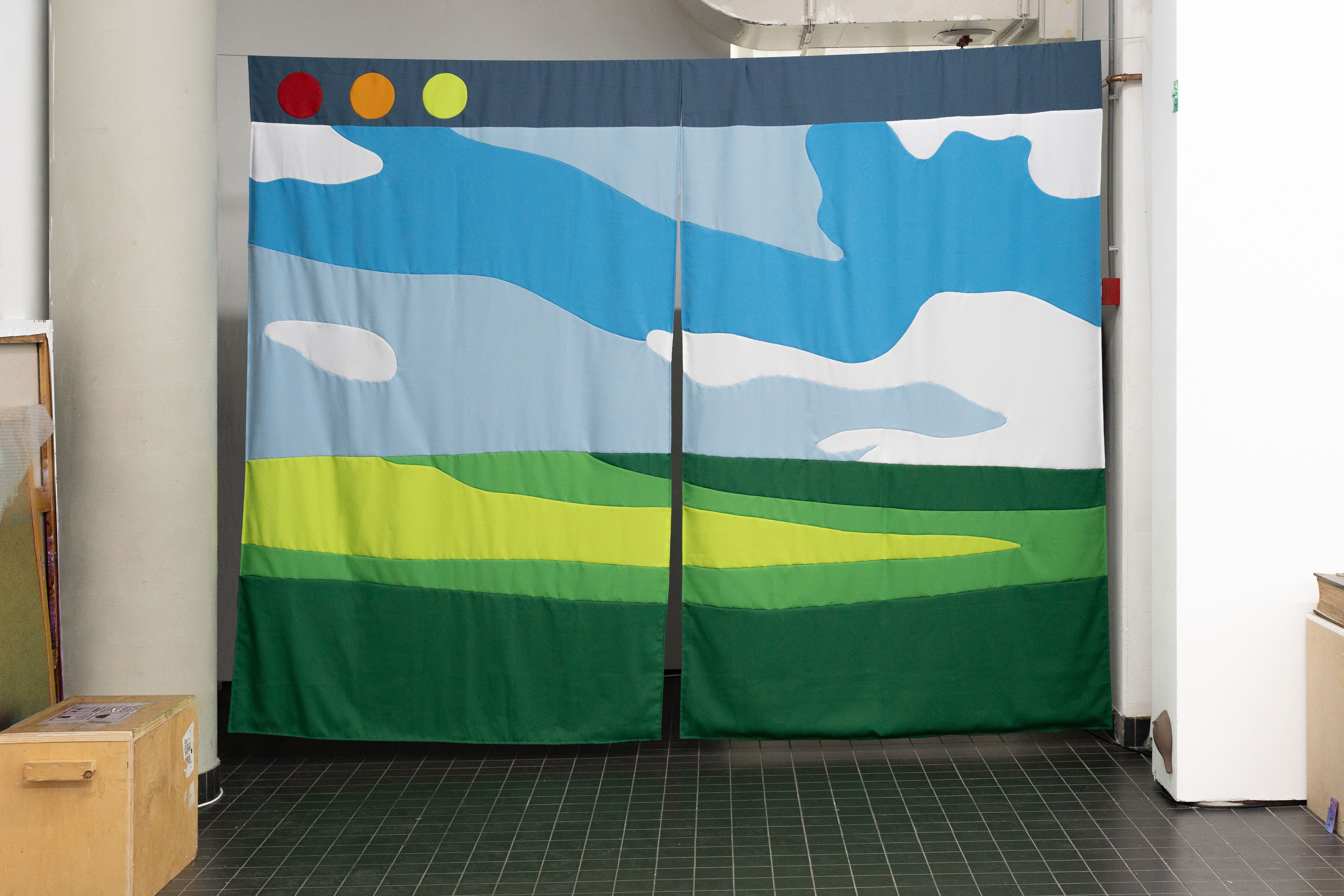
textile curtain, earthenware
In this installation the objects are playing with the metaphors of digital environments. The patchwork curtains is designed as a computer window, with a view of a green hill, inspired by the iconic background image of the Windows XP operating system. The ceramic mice, shaped like contemporary chimeras, blur the boundaries between the digital and the natural, much like the word itself, which has become hybrid today.
rideau textile, faïence
Dans cette installation, les objets jouent avec les métaphores des environnements numériques. Les rideaux en patchwork sont conçus comme une fenêtre d'ordinateur, offrant une vue sur une colline verdoyante, inspirée de l'image d'arrière-plan emblématique du système d'exploitation Windows XP. Les souris en céramique, aux formes de chimères contemporaines, estompent les frontières entre le numérique et le naturel, à l'image du mot lui-même, devenu aujourd'hui hybride.
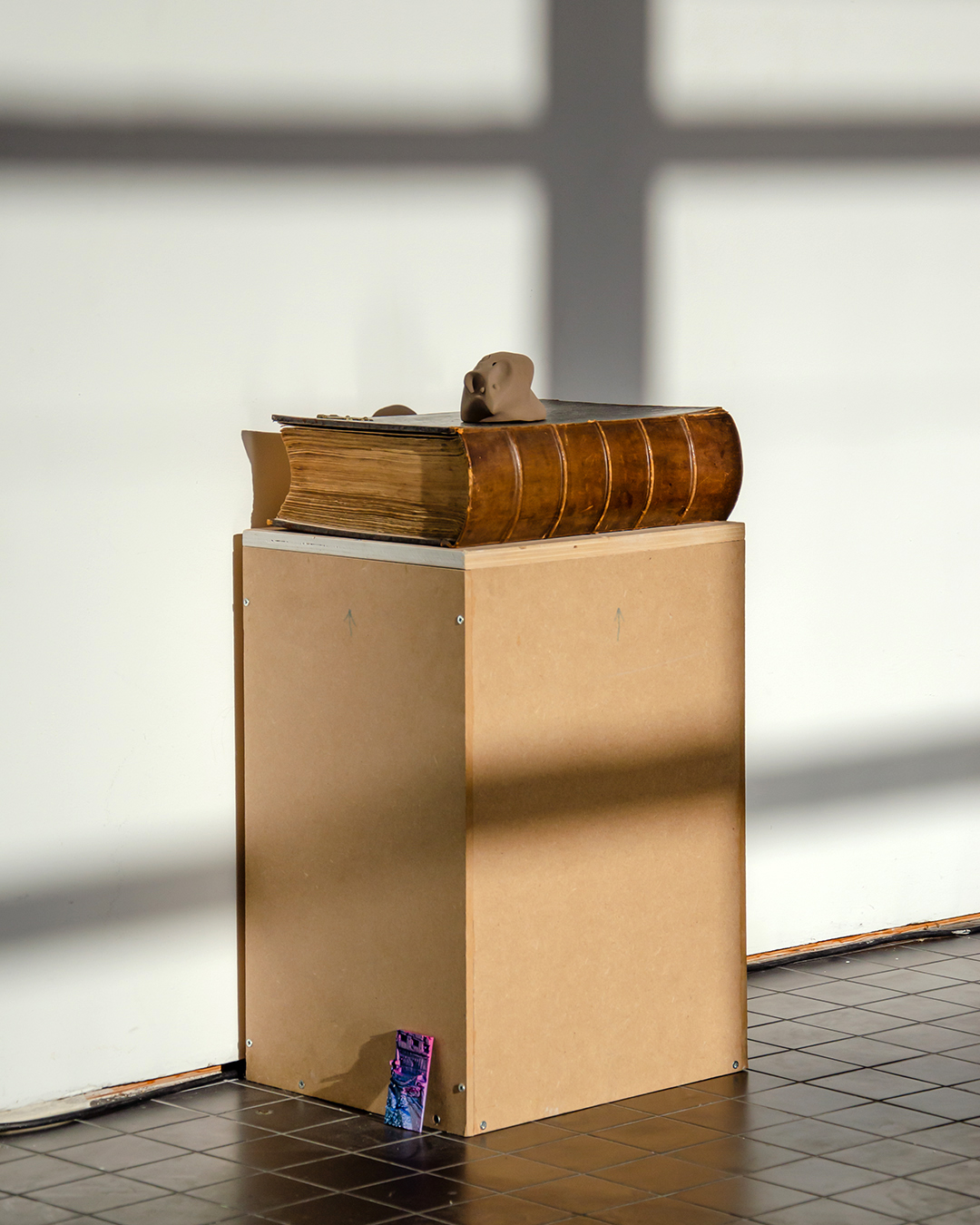

Installation made for the exhibition “Autopoïèse” at the Tour Orion, a space with artists ateliers in Montreuil (FR) in June 2024. Here the objects play with words, have fun and get sidetracked. Window envelopes are used here to broadcast videos. Referring to Internet and computer windows, digital scenes come to life behind the plastic screen, originally used to display the addresses of postal recipients.
L’installation « View from the Window » a été réalisée pour l'exposition « “Autopoïèse” » auto-organisée des artistes résident·es de la Tour Orion à Montreuil (FR) en juin 2024. Ici les objets jouent sur les mots, s’amusent et se détournent. Les enveloppes dites « à fenêtres » sont ici utilisées pour diffuser des vidéos. En référence aux fenêtres de navigateur internet et d’ordinateur, des scénettes numériques s’animent derrière l’écran de plastique, originellement utilisé pour afficher les adresses des destinataires des courriers postaux.

Onsite Website: The Official Emoji Shop uses the shop window as a metaphor for a computer screen. More precisely, it embodies an online sales site, called a "webshop", where all the products are also inspired by digital objects: emojis. These icons, widely used in our online interactions, seem to double our environment and even our very existence. Presented here as functional objects, these sculptures blur the boundaries of the recurring opposition between the digital and the physical. At a time when shops are disappearing from city centres and online shops are flourishing, The Official Emoji Shop is taking up ironic residence for 3 months at 29 rue de L'université Art au Centre Liège #13, in a deserted shop window.
Onsite Website : The Official Emoji Shop utilise l’espace de la vitrine comme la métaphore d’un écran d’ordinateur. Elle incarne plus précisément un site de vente en ligne, appelé « webshop », où tous les produits sont eux-aussi inspirés d’objets numériques : les émojis. Ces icônes, largement utilisées dans nos interactions dites « en ligne », semblent doubler notre environnement jusqu’à notre propre existence. Ici présentées comme des objets fonctionnels, ces sculptures brouillent les frontières de la récurrente opposition entre numérique et physique. À l’heure où les boutiques disparaissent des centres-ville et où les magasins en ligne fleurissent, The Official Emoji Shop s’installe avec ironie pendant 3 mois au 29 rue de L’université pendant Art au Centre Liège #13, dans une vitrine désertée de sa boutique.


The pixels from IMG_6161.jpg – a picture of the Dutch sky –, are reorganised in several ways thanks to an algorithm. Displayed on the flags, the new images composed of the exact same pixels – or colors – act as a filter on the sky of Heerlen, inviting to reconsider our perception of digital images.
Curators: Josephine Kaeppelin, Roy Voragen, Wouter Huis.
Algorithm written by Elouan Raffray.
Les pixels de IMG_6161.jpg – une image du ciel néerlandais – sont réorganisés de différentes façon grâce à un algorithme. Exposé sur ces drapeaux, les nouvelles images composées exactement des mêmes pixels – ou couleurs – agissent comme un filtre sur le ciel d’Heerlen, invitant à reconsidérer notre perception des images numériques.
Commissaires : Josephine Kaeppelin, Roy Voragen, Wouter Huis.
Algorithme écrit par Elouan Raffray.
Our understanding of reality is challenged by the increasing presence of digital devices. On-screen representations, shaped as simulations, are seemingly doubling our surroundings and even our own existence. The wide use of emojis affects off-screen spaces, bodies and interactions as they become referential for our mental representations.
In “The Apple Pie”, the manipulation of the material becomes a dissection of the digital representations that inhabit our screens, in an attempt to understand what is hidden behind them.
What could be better than sharing a homemade pie, especially an Apple one, to Think Different?
Notre compréhension de la réalité est constamment remise en question par la présence croissante des appareils numériques. Les représentations à l’écran, sous forme de simulations, semblent doubler notre environnement et même notre propre existence. La grande utilisation des emojis affecte les espaces, corps et interactions non numériques à mesure qu’ils deviennent des référentiels dans nos représentations mentales.
Dans « The Apple Pie », la manipulation de la matière se présente comme une dissection des représentations numériques qui habitent nos écrans, dans une tentative de comprendre ce qui s’y cache derrière.
Quoi de mieux que de partager une pie (« tarte ») faite maison, et particulièrement une Apple Pie (« tarte aux pommes »), to Think Different (« pour penser différemment ») ?

Photos: Éloïse Alliguié & Sander van Wettum
Photos : Éloïse Alliguié & Sander van Wettum


This beta version of "The Apple Pie" was selected in the series "Snack or Foodpill" of the One Minute Foundation (Amsterdam, Nl), in February 2022. It was screened in this context at W139 (Amsterdam, Nl), Het Nieuwe Insituut (Rotterdam, NL) and during the 68th International Short Film Festival Oberhausen (DE), and the Reykjavík International Film Festival (IS).
Cette version bêta de « The Apple Pie » a été sélectionnée dans la série "Snack or Foodpill” de la One Minute Foundation (Amsterdam, Nl), en Février 2022. Elle a été diffusée dans ce contexte à W139 (Amsterdam, Nl), Het Nieuwe Insituut (Rotterdam, Nl) et pendant le 68ème Festival international du court-métrage d’Oberhausen (De), ainsi que le Reykjavík International Film Festival (IS).
This alpha version of "The Apple Pie" is a preparatory video that presents a sample of several scenes and their possible variants.
Cette version alpha de « The Apple Pie »est une vidéo préparatoire qui présente un échantillon de plusieurs scènes et leurs possibles variantes.
Artificial intelligence are trained with datasets that are organized in categories. The labelling of the latter inevitably induces bias during the learning process of the algorithms that are perpetuated every time it is then used.
In this short experiment, Éloïse played with an existing algorithm and fed it with images in a way that only the digital alter ego of the visualized objects are recognized, i.e. Éloïse, a painting, flowers and windows.
Les intelligences artificielles sont entraînées avec des ensembles de données organisés en catégories. La labellisation de ces dernières induit inévitablement des biais lors de l’apprentissage des algorithmes, qui se perpétuent ensuite à chacune de ses utilisations.
Dans cette expérimentation, Éloïse joue avec un algorithme existant et l'alimente à son tour avec des images de sorte que uniquement les alter ego numériques des objets présentés à la caméra soient reconnus.

Doesn’t the time spent communicating on our phones deepen our intimacy with our devices rather than with our interlocutors? By touching it, caressing, squeezing it in our hands, falling asleep or waking up with it, our body is physically engaged with the devie itself, its materials.
This silicone phone shell has been conceived as a tactile experience for the user, playing with textures, like the pulpit, enhances the user’s tactile experience, in the light of the pulpit.
Le temps passé à communiquer sur nos téléphones n’approfondit-il pas notre intimité avec nos appareils plutôt qu’avec nos interlocuteurs ? En le touchant, caressant, serrant dans nos mains, lorsque nous nous endormons ou réveillons avec lui, notre corps est physiquement engagé avec l’appareil lui-même, ses matériaux.
Cette coque de téléphone a été conçue comme expérience tactile pour l’utilisateur grace à un jeu de texture, à l’image de la chaire.

In this research project, the pixels from an image are used as material to create new shapes. Digital and more tangible manipulations are experimented with and shown through a performance, before and after.
“Jimmy in Paradise” refers to an image used as an example to test the possibilities of the early editions of Photoshop. Named “Jennifer in Paradise”, this image with a topless woman on an idyllic beach is known as the ‘first photoshopped image’.
The performance and installation were produced in the context of the annual joint exhibition and performance program ‘Rietveld Uncut’ at the Stedelijk Museum, Amsterdam (NL). The event on the 25th-29th of March 2020 was cancelled due to the governmental coronavirus regulations, and replaced by an online program with videos.
Dans ce projet de recherche, les pixels d'une image sont utilisés comme matériaux pour créer de nouvelles formes. Des manipulations numériques et d'autres plus tangibles sont expérimentées et montrées avant, pendant et après une performance.
« Jimmy in Paradise » fait référence à une image utilisée comme exemple pour tester les possibilités des versions beta du logiciel Photoshop. Nommée « Jennifer in Paradise », cette image d'une femme en topless sur une plage idyllique est connue pour être la ‹ première image Photoshoppée ›.
La performance et installation ont été produits dans le contexte du programme annuel d’expositions et de performances « Rietveld Uncut » au Stedelijk Museum à Amsterdam (NL). L’évènement du 25 au 29 Mars 2020, annulé en raison des régulations gouvernementales liées au coronavirus, fut remplacé par un programme en ligne de vidéos.
Collecting personal data can be quite an adventure. The numerous gathered files from online platforms are well organized but not made to be understandable. They’re about ourselves but we can’t have full access to their information because of their complexity, or sometimes just because our computer doesn’t have the right software to open the files.
The musical piece “Computer Music” is an exploration through those collected files. Éloïse and her computer are reading their name, the error messages that occur or their abstract content, on a musical background by Philippe Katerine, “Musique D’Ordinateur”.
Collecter ses données personnelles sur internet peut se révéler être une aventure. Les nombreux fichiers amassés auprès de plateformes internet sont très bien organisés, mais pas toujours faits pour être compris correctement. Ils sont notre propos, mais nous n’en avons pas un complet accès, à cause de leur complexité ou parfois simplement parce que notre ordinateur n’a pas le bon logiciel pour ouvrir lesdits fichiers.
La pièce musicale « Computer Music » est une exploration au travers des fichiers collectés. Éloïse et son ordinateur entreprennent une lecture de leurs noms, de leurs contenus abstraits ou encore des messages d’erreurs qui peuvent apparaître, sur un fond musical de Philippe Katerine, « Musique D’Ordinateur ».


“The Window” is a demonstration of a window derived from the ones we have on our computers, exploring a speculative “reversed” skeuomorphism, when digital devices are part of our landscape and maybe our new frame of reference. This piece opens a reflection on the influence of digital devices and interactions on our analog surroundings and communications.
« The Window » est une démonstration d’une fenêtre, dérivée de celles que l’on trouve dans nos ordinateurs, explorant un skeuomorphisme « inversé » spéculatif, quand le numérique fait partie de notre paysage et devient peut-être notre référentiel. Cette pièce ouvre une réflexion sur l’influence des appareils et interactions numériques sur notre environnement et nos modes de communication analogiques.
The video proposes explanations of the possible origins of visual stereotypes used when talking about ‘the digital’, through a collection of images gathered from several image search engines.
La vidéo propose des explications des possibles origines des stéréotypes visuels associés au numérique, à travers une collection d’images collectées sur plusieurs moteurs de recherches.

The installation consists of a diptych that illustrates this duality, completed with texts, like scenarios of the two pictured scenes.
L’installation se compose d’un diptyque qui illustre cette dualité, complété de textes, comme des scénarios des deux scènes imagées.

The two publications – each devoted to a flatbed scanner – are presented as reference points for the distance glass-object. Samples of raw materials – wood, felt, metal, paper – and images are placed on the scanner glass at different distances – from 0.2 to 5.0 cm. Changing shades of the scanned subjects takes the shape of a colour chart.
Les deux publications – chacune se consacrant à un scanner à plat – se présentent comme des référentiels de distance vitre-objet. Des échantillons de matériaux bruts – bois, feutrine, métal, papier – et d’images sont ainsi posés sur la vitre du scanner, à différentes distances – de 0,2 à 5,0 cm. La modification des teintes des sujets scannés prend la forme d’un nuancier.

The publications are made up of scans of printed spaces that need to be recomposed. Like a pattern, these volumes seen through the glass of a scanner become surface and unfold like a double.
Les publications sont composées de scans d’espaces imprimés à recomposer. À l’image d’un patron, ces volumes vus à travers la vitre d’un scanner deviennent surface et se déploient comme un double.
Éloïse Alliguié (Lyon, 1997) is a visual artist who graduated in 2022 with a Master’s degree in F For Fact from the Sandberg Instituut (Amsterdam, NL). She uses parody and the absurd to explore our relationship with the digital world. Her videos and installations, which are both playful and reflective, blur the boundaries between the real and the virtual. Éloïse creates sculptures directly inspired by screens, lending a new tangibility to the digital objects that inhabit our daily lives.
The objects Éloïse creates prompt reflection on the visual language of digital interfaces and its critical implications. Her studies in graphic design led her to view the image as a means of communication that is far from neutral. Screens reveal a host of simulations and metaphors, such as the ‘cloud’, which suggests lightness, even though it is fraught with material and environmental implications.
Website designed & coded by Éloïse Alliguié.
Typeface AmiAmie released by ByeBye Binary